Feeds:
Posts
Comments

Photo credit: bridgeandtunnelclub.com

The Seattle Public Library is running an online voters guide and checking facts on a range of issues in the Washington State and Federal elections.  Hurray for them.  Their site is called the Living Voters Guide.  It covers some hot-button issues including same gender marriage, legalization of marijuana and charter schools.

A recent blog on the Seattle Times website had a headline calling this a risky experiment, but valuable  and describes how it works and some of the issues that have arisen for the librarians supporting this resource.  I disagree with the headline and the characterization of this as being risky.  This is exactly what our profession should be doing, particularly because we can assess, evaluate and curate information sources so well.

_______________________

BTW, as you can see I have taken an extended break from blogging here.  I’m now focusing on getting back into it on a more regular basis.

Photo credit: St. Louis County Library

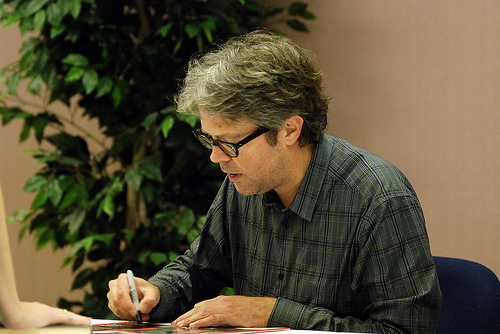
Speaking recently in Colombia, bestselling author Jonathan Franzen decried the emergence of eBooks, apparently saying that impermanence of eBooks is incompatible with enduring principles.  I disagree.  I think the two are unrelated.  His comments remind me of Clifford Stoll’s book, called Silicon Snake Oil, that was published in 1996 and so badly predicted that the Internet would not live up to the predictions that many were making at the time.  He was entirely wrong, in part because he did not imagine the savvy adaptations that would emerge in the decade after his book was published.  He also did not imagine the widespread adoption of digital technologies into everyday life.

I feel that Mr. Franzen in making a similar mistake.  One compelling statistic is the dramatic rise in ownership of eBook readers and tablet computers in late 2011, as announced by the Pew Research Center.  Ownership by adults for both kinds of devices rose from 10% to 19% in just over a month.  That’s compelling data, strongly demonstrating the digital shift that world is undergoing.

Libraries are struggling to keep up with the eBook phenomenon, hampered in part by rapidly shifting relationships between themselves, publishers and eBook vendors that broker licenses, access and prices between publishers and libraries.  It’s a world where the sands will continue to shift for a while.

That said, I find it very interesting that one well-known U.S. bookstore, Barnes & Noble, is gearing up for the eBook future and challenging Amazon and its Kindle.  The New York Times described the efforts in a recent article.  It’s an uphill battle and it’s clear from the article that publishers are aware of the challenge that B&N faces.  A debate on this morning’s CBC radio program Q, which covers the arts, explored the tension between online bookstores such as Amazon and independent bookstores.

There is a growing consensus that there is a symbiotic relationship between eBooks and printed books, between online vendors and in-person, real life stores where you can talk to a sales rep and walk out with a printed-on-paper, bound book in your hand.  I agree.  It’s not either or, but rather that reading and the demand for books is multiplying because of both.  They leverage off of each other.

Libraries must continue to stay on top of trends and issues related to eBooks and innovate as needed if THEY are to stay relevant as the landscape changes.

Firstly, I’m really pleased I’ve been approved to do a presentation at the BC Library Association conference in May.  Two other presenters will join me to talk about innovative organizational culture in libraries, using the nine principles that I described in my January 9th post.

I’m also following other initiatives that show early promise for breaking new ground and connecting libraries with innovation.

The Harvard Library Innovation Laboratory consists of a small group of tech-savvy librarians trying out ideas by creating them in usable form. As they say on their site, much of the software they build will be simply proof-of-concept, as opposed to production-quality code, but some will be developed more fully.  Check out the site for more detail about three of their projects, ShelfLife, StackView and LibraryCloud and a number of their investigations.

The Library as Incubator Project is focusing on arts by featuring (according to the site):

  • “Visual artists, performing artists, and writers who use libraries in their communities for inspiration, information, and as gallery space;
  • Collections, libraries and library staff that incubate the arts, and the ways that artists can use them effectively;
  • Free-to-share resources for librarians looking to incubate the arts at their libraries;
  • Ideas for artists looking to connect with their communities through library programming.”
These are indeed very positive developments for libraries and those who use and support them.  There have been many recent forecasts that the end of libraries is nigh.  These and other initiatives could prove those forecasters to be wrong.

One of the purposes of this blog is to feature and explore innovation in libraries.  Staying relevant and succeeding in the coming decade will require that libraries undergo reinvention and renewal through intentional, ongoing practices within our organizations and in partnerships with others.  Using the so-called “Google 9” principles of innovation (there are several variations around the Web), I am proposing the following adaptations and elaboration for libraries:

1. Ideas come from everywhere — anyone in any unit or department, regardless of position can propose an innovative idea and it will be considered.

2. Innovation, not instant perfection – test early and often and evaluate based on small versions or pilot projects.

3. License to pursue dreams – allow individuals opportunities and flexibility to pursue ideas and concepts that interest them (and that are relevant to creating/sustaining an innovative organization).

4. Morph projects, don’t kill them – there are often useful, effective elements of programs or services that can be preserved or transferred to a renewed or updated version or to other initiatives.

5. Share as much information as you can – ensure internal mechanisms are in place that enable collaboration.

6. Users, users, users – continually bring their focus and feedback into discussions around planning, implementing and evaluating programs and services.

7. Data is apolitical – organizational hierarchy, authority and influence still matter, but be rigorous in the use of metrics.

8. Creativity loves constraints – articulate the vision, then set parameters for available resources and timelines or deadlines.

9. You’re brilliant?  We’re hiring – recognize innovators when you see them, hire them if you can, or if you can’t, consider collaboration or other ways to get them involved.

While innovation is commonly tied to technology, it’s also important to focus on non-technological means to find new and creative ways of offering or supporting programs and services that are linked to the needs of users.
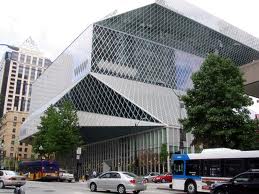
A few years ago when I gave a presentation on the future of libraries I used a prediction offered by Professor Joseph Janes from the University of Washington’s iSchool, that a library is essentially made up of five basic categories:

  1. Stuff
  2. Help
  3. Place
  4. Values
  5. Interaction

After my presentation the participants broke into small groups and discussed what might change for each category as well as what might stay the same and what factors will likely influence what libraries will be doing in the future.

Recently there have been some news stories that focus on public libraries that are offering high-tech “hackerspaces” or tech shops as part of what their services.  The Fayetteville Free Library in New York State is developing a “Fab Lab”, a free high-tech space that allows users access to machines and software in order to design and fabricate things.  What things, you might ask?  So far except for 3D printing the predictions are a little vague.  The products will be most likely be moulded out of plastic (although the high-tech fabrication machines also work with wood and other materials), they will be three dimensional, and they are meant to be functional; lots of opportunity for the DIY set, in other words.

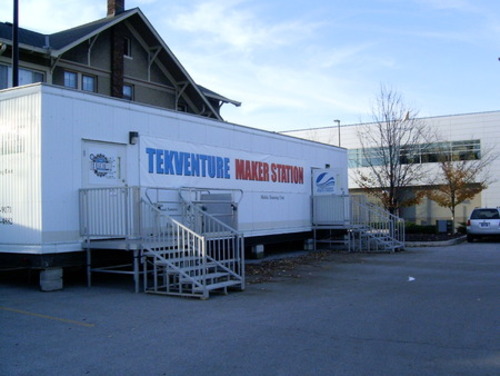
The Allen County Library in Fort Wayne, Indiana has another example they are calling the TekVenture Maker Station.  TekVenture is a non-profit organization with a tag line that speaks to interconnecting imagination, technology and community.  It and the library are partners in this small but ambitious endeavour.

TekVenture Maker Station (photo credit: TekVenture.org)

It’s much too early to know whether these efforts will be adopted more broadly and become more mainstream.  But they do speak to all five of the library categories offered by Prof. Janes.  In this case the users create the stuff with the help of the library that provides a place for learning through interaction or collaboration with partners so that creators can interact with others in their own learning.  As for values, Allen County Public Library’s director, Jeff Krull says that libraries are “in the learning business and the exploration business and the expand-your-mind business”, and so he says, the Maker Station fits with the library’s mission.

If you want to hear the radio coverage of these efforts that was aired by CBC’s Spark program here is the link to the podcast of the episode (#166).  Scroll down to the audio portion called “Hacking the Library”.

In an October 2011 ITI Newlink article, Nancy K. Herther described a battle between OverDrive, the global provider of digital content,  and the Kansas State Library over the terms of their contract and pricing for eBooks.  One of the fundamental issues for libraries in the provision of eBooks to users, has been the ownership of content that they have purchased from eBook vendors and their right to lend that content —  not just through the duration of their contracts or licenses, but after the contract has ended.  Until recently libraries have assume that they owned the content and vendors have not claimed otherwise.

But with the skyrocketing adoption of eBooks, more and more publishers and vendors have taken a contrary position, claiming that libraries are only buying access and only for the duration of the contract.  In one of the most audacious moves by a publisher, HarperCollins decided to restrict the lending/downloading of eBooks to 26 occurrences on each library website, at which point the library would need to pay again for access to that content.  This caused an uproar and HarperCollins has faced harsh criticism for its announcement.

As Ms. Herther’s article states, the Kansas case raised a variety of important issues and problems in the eBook industry, including competition over platforms, buyers’ rights and the still unstable relationship of eBook vendors with publishers, libraries and consumers.  With the relationships continuing to take shape, libraries are adapting to various methods of providing this form of digital content to users.  However, one well known librarian, Sarah Houghton-Jan (aka the Librarian in Black) feels that the licensing relationship with eBook suppliers has been a huge mistake.  She points to non-profit models such as the Open Library project and Library Renewal and others as one possible way out of the current conundrum.

The story is far from over, but the Kansas State Library’s battle holds lessons for libraries in many other jurisdictions.

Surrey's City Centre Library

The new City Centre Library in Surrey officially opened on Saturday, attracting hundreds of people to the ceremonies and the day’s entertainment.  The iconic 77,000 sq. ft. building is a key element of the city’s new city centre.  Under construction right next door is a new city hall and a performing arts centre.  Just a block away is a busy transit hub and Simon Fraser University’s Surrey campus. The strategic location of the new library will enable all kinds of important partnerships that support learning and innovation in a city that is an emerging powerhouse on the Canadian and global stage.

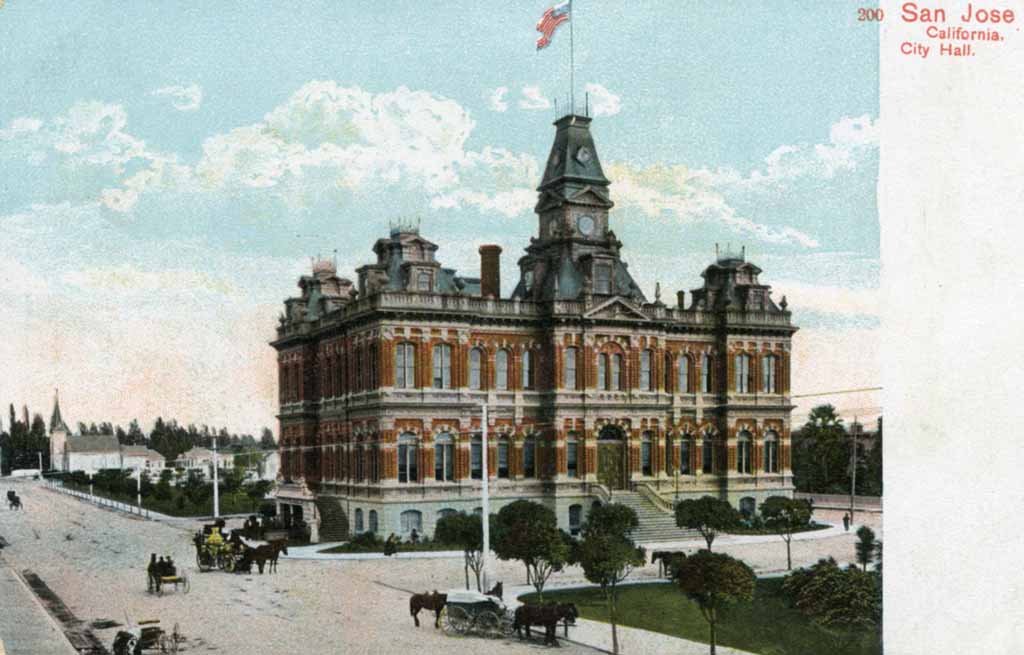
Photo Credit: San Jose Public Library

The San José Public Library launched an augmented reality site recently and announced it on its blog on September 10th in a very down to earth post  Augmented reality layers information on top of a view of the real world, typically on a mobile device.  In this case historical photos and documents from the library’s local history collection have been chosen to augment three different walking tours near the city’s downtown.  The website for this augmentation has been branded as Scan José, which is cute and memorable.

This site also enables one to view the images in 3D by downloading the appropriate application from iTunes or the Android Marketplace.  Very cool!

With Labour Day now over post-secondary institutions and their libraries are once again welcoming new and returning students on campus. Many of these libraries are discussing and planning services that match the current trends in the field.  What are these trends?  According to a June 2010 report of the Association of College & Research Libraries there are 10 top trends underway in academic libraries.  I’m listing the trends below exactly as they are written in the report, except that I’ve changed the order.  The report has them in alphabetical order, which is oh so librarian-like, don’t you think?

  • The definition of the library space will change as physical space is repurposed and virtual space expands;
  • Changes in higher education will require that librarians possess diverse skill sets;
  • Increased collaboration will expand the role of the library within the institution and beyond;
  • Libraries will continue to lead efforts to develop scholarly communication and intellectual property services;
  • Technology will continue to change services and required skills;
  • Explosive growth of mobile devices and applications will drive new services;
  • Academic library collection growth is driven by patron demand and will include new resource types;
  • Digitization of unique library collections will increase and require a larger share of resources;
  • Demands for accountability and assessment will increase;
  • Budget challenges will continue and libraries will evolve as a result.

I live in Metro Vancouver, so as I discuss trends and issues with colleagues and visit library buildings and websites I see what one would expect, namely that each institution is aware of these trends but is incorporating services that align with them at its own pace.  For example the development of a Learning Commons or Research Commons as a key set of resource for academic success is expanding in local post-secondary institutions, both in terms of physical spaces and virtual content.  This development involves a convergence of a number of the top 10 trends described by ACRL, including collaboration between libraries and other partners, technological shifts, repurposing of physical space, diverse skill sets amongst library staff and assessment of and accountability for the resources invested in these initiatives.

Since 2002 the New Media Consortium’s Horizon Project has issued an annual report describing and predicting the impact of emerging technologies in the coming five years.  Libraries of all kinds, but particularly academic libraries use this report as a guide to planning for investments in new technology, training and initiatives that will help them to better serve their users.

Not surprisingly, the 2011 Horizon Report states that eBooks and mobile devices are moving closer to mainstream adoption for educational institutions in the near term.  In the report’s “second adoption horizon” (two to three years) augmented reality and game-based learning are seen as the two technologies most likely to influence post-secondary education.  Augmented reality layers information on top of a view of the normal world (typically on a mobile device).  For example students walking by a building on campus can sync their device to a positional signal and it will display information about the building (e.g. a directory of offices inside, when it was built, the architect, etc.).  Game based learning for individual students or small groups can be integrated into coursework.  Great potential lies in the ability to stimulate technology-supported collaboration, problem-solving and procedural thinking.

Looking still farther ahead, the report suggests that in four to five years, gesture-based computing and learning analytics will become more commonplace on campuses.  Gesture based computing is essentially “wearable technology” that responds to body motion instead of a keyboard or mouse for computer input.  Learning analytics uses data gathering tools to enable study of student engagement, performance and practice, with the goal of using this data to revise curricula, teaching and assessment in real time.  In other words, this is technology designed to stimulate and support very dynamic learning environments.

Academic libraries will no doubt be watching these trends and collaborating with faculty and instructors to review and evaluate the predictions described in the report, and then plan services around their findings.