Feeds:
Posts
Comments

The growing City of Surrey, east of Vancouver, Canada is charting a bold new future by investing in new capital projects, the development of a clean energy hub, establishing new business incubators, strengthening partnerships with local post-secondary institutions and the board of trade, and eliminating outdated city regulations and processes.

The centerpiece for Surrey’s new city centre will be a new 77,000 square foot library, next to a new city hall, and just a block away from Simon Fraser University’s local campus and a large hub for public transportation.  The City Centre Library was designed by the award-winning architect, Bing Thom.  An official grand opening ceremony set for September 24th.

This development will be a great example of how the presence of libraries have a positive impact on downtowns, commercial areas and neighborhoods.  Such impact is an important factor described in “Making Cities Stronger: public library contributions to local economic development” a report published by the Urban Libraries Council in 2007.

Even prior to the opening there strong evidence of the benefits of the partnerships emerging from Surrey’s economic investment plan and its new city centre.  For example, SFU’s Continuing Studies program has agreed to offer a wide range of courses at the City Centre Library.
This year marks the 100th anniversary of the British Columbia Library Association.  The centenary was celebrated at the association’s annual conference in April.  A well written, beautifully illustrated history of library service in the province called “The Library Book” by Dave Obee was featured at book launch event during the conference.  This past weekend an interview Mr. Obee was aired on CBC radio’s popular weekend program, North by Northwest.  Here’s the podcast from July 17, 2011.

If you think the history of libraries might be kind of boring, well think again.  Obee captures some of the personal sacrifices and drama that occurred over the decades.  In one example, police arrived at a library wanting all the copies of Henry Miller’s “Tropic of Cancer”.  The librarian stood her ground and wouldn’t hand them over.  Thank goodness.  Who knew. . . until now.

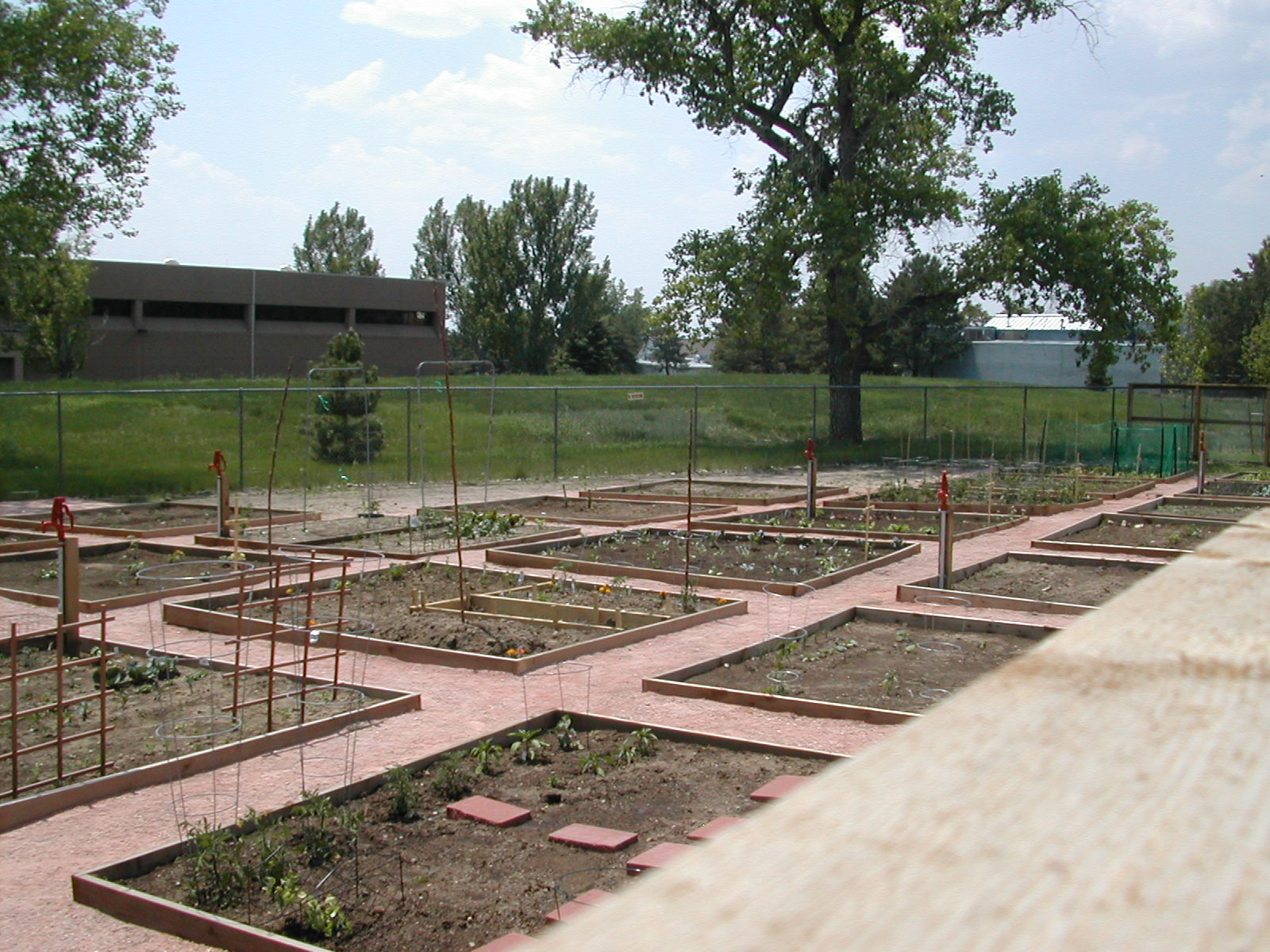
The Anythink libraries are literally breaking new ground in their efforts at building community and developing partnerships.  At two locations, Commerce City and Perl Mack, community gardens are taking shape on plots just outside the libraries.  They were planned in partnership with Denver Urban Gardens.  Anythink’s goal is to focus 50% on food production and 50% on community building.  As focal points for the neighborhoods, there will be workdays that bring gardeners and passers-by together as well as discussion about sustainable gardening and what grows well and what doesn’t.  “Read, think, eat” is one heading in a recent library newsletter describing the project.  What better place but at the library?

The summer reading program at Anythink libraries has stepped away from the often-used model of providing participants with prizes and coupons from local merchants and fast food vendors.  Gone also are the tally sheets that track reading volume over the summer.  Their “My Summer” program is focused on learning and creativity based on the thinking that reading stimulates.  So it’s more about quality than quantity.  Of course the challenge for parents with kids in this or any program is to help develop realistic goals for the products of young, creative thinking and to support children in reaching those goals.  I think this model has greater potential than the more often-used ones, for enriching a child’s life experience based on the reading they do over the summer.

I look forward to watching how the Anythink libraries evolve and change over time.  They have challenged and disrupted (in a respectful way) many long-held public library conventions.  Their success may help lay the foundation for the survival of public libraries in the face of threats from diminishing relevance in the crowded “attention marketplace” of our current era.

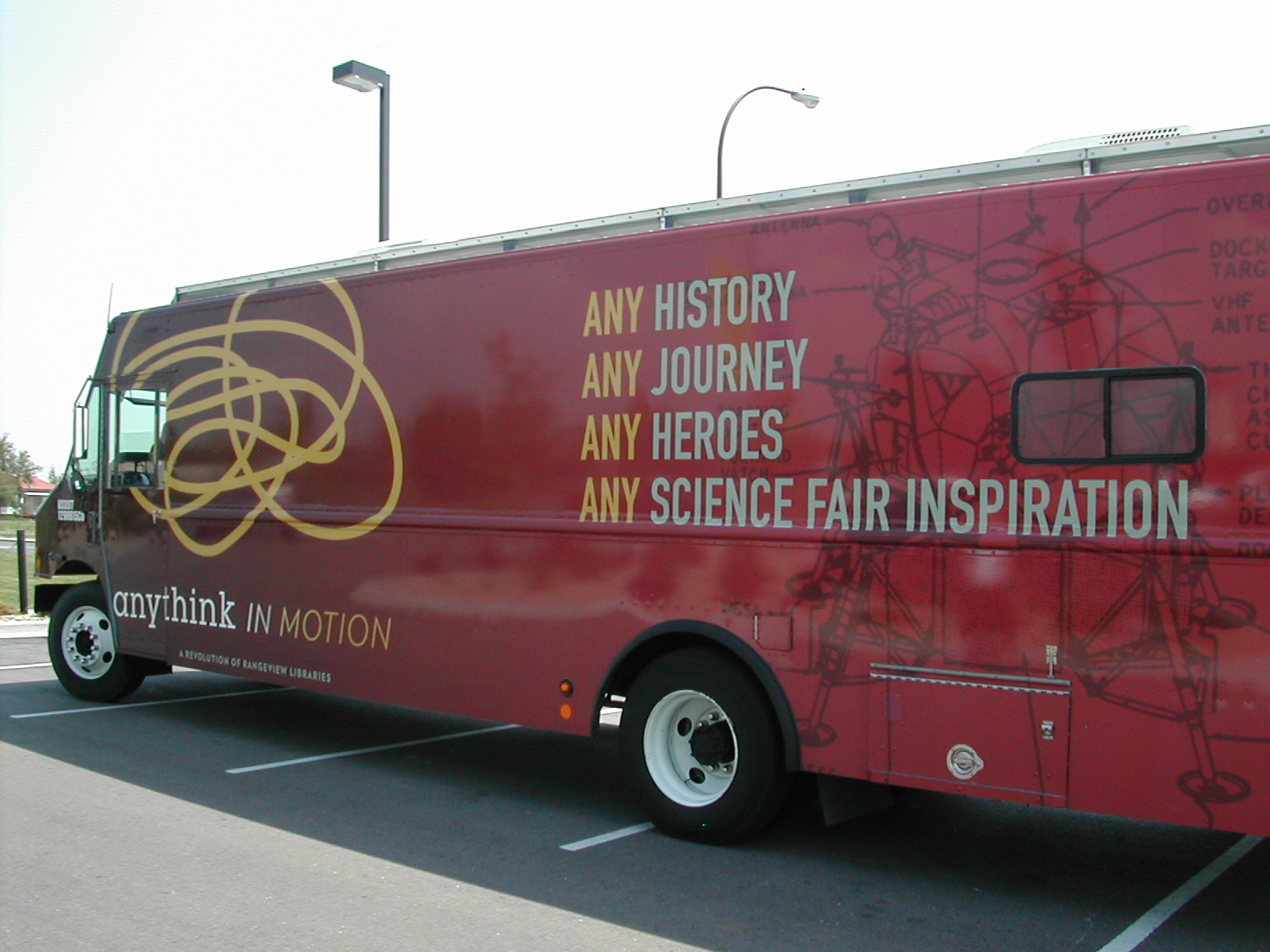
Anythink is the brand name for seven cutting edge, revolutionary libraries in Adams County, Colorado. To be more specific, as their signage clearly says, the seven Anythink locations and the bookmobile (aka “Anythink in motion”) are the neighbourhood service points for the Rangeview Library District.

Libraries don’t often embrace branding in the way Anythink has done. In fact some reject the concept entirely. But as an outcome of branding and what Anythink managers themselves call a disruptive approach to the provision of library services, the results have been phenomenally positive. In 2003 the Denver Post labelled the Adams County Public Library, as Anythink was then known, the “worst in [the] state”. Fast forward to 2010 when compared to 2009, checkouts increased by 50%, the number of library card holders went up by 30% and visits to the website rose by 84%. Public approval is rising and there’s a buzz in the library community about Anythink.

Anythink’s director, Pam Sandlian Smith and staff at four locations hosted me and my colleague Mary Somerville in a daylong tour. Also, they very generously arranged for Anythink in motion to take time from its busy schedule for a rendezvous and photos.

Pam, the staff and her Board have successfully rallied behind the brand and some positive disruptions to the usual conventions in public libraries. Gone is the Dewey system which has been replaced by “WordThink”, a method adapted from bookstores for arranging books and DVDs, etc. on shelves. Fines are not charged for overdue items, food and beverages are allowed, librarians are known as Guides and branch managers double as Experience Experts. These are more than just cosmetic changes, and reflect a hip, innovative and creative organizational culture.

In addition to these positive disruptions, new and renovated buildings are open, inviting and beautifully designed. Clearly, Anythink libraries have layout and design features that provide flexibility, a welcoming, comfortable environment and intuitive access to books, magazines, computers and to staff. Those staff members readily detach themselves from desks to roam the floor, to chat with and engage customers without being intrusive.

In my next post about Anythink I will highlight other of its initiatives that help build community in the area, and go beyond just thinking to creativity and learning.

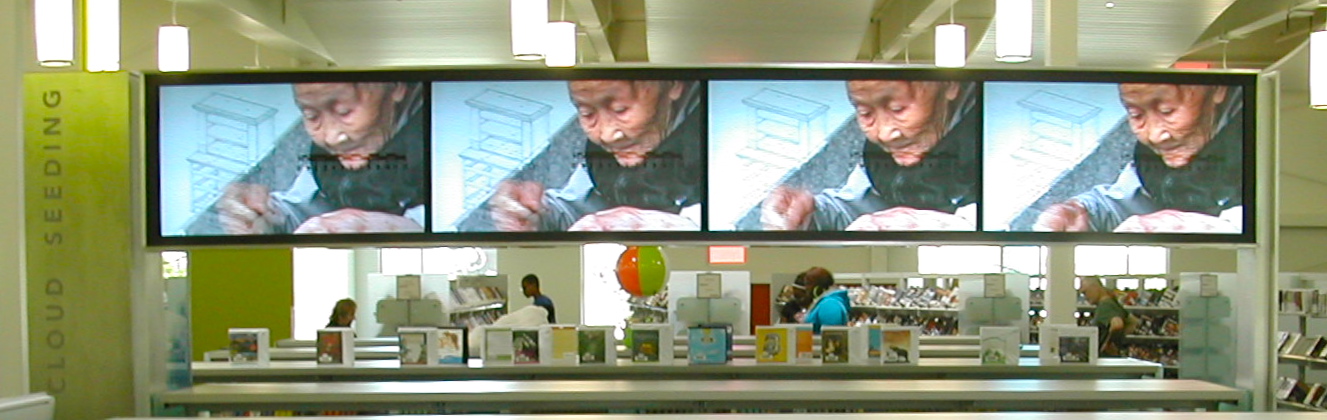
“Cloud Seeding”

by Erik Carlson, a participatory electronic art installation at the Green Valley Ranch branch of the Denver Public Library

Before visiting the anythink libraries in nearby Adams County, I took in the Green Valley Ranch branch of the Denver Public Library (DPL).  Cori Jackamore, the co-manager of Children’s and Family Services gave me and my colleague, Mary Somerville, an enthusiastic and informative tour of this new and innovative library.

DPL has implemented a model that offers service options that vary by branch or neighborhood.  Some branches specialize by offering programs, books and materials focused on certain age groups or interests.  So customers need to learn which locations are best for their age and interests.  This is a flexible model that can be tweaked to meet changing needs.  For example the Green Valley Ranch library caters primarily to children who visit with their parents, and to teens that attend a nearby middle school.

Opened in March 2011, the branch is designed for maximum flexibility.  Many bookshelves are actually on wheels, as are the sleek looking tables, which can be moved apart and back together in different configurations.

The innovative features that popped up for me were these:

  1. A community room that could blend easily with the rest of the library, as opposed to being off in one corner or edge of the building.  A stylish and moveable “garage door” wall allowed for easy overflow when the library was busy and also for self-contained meetings and programs when needed;
  2.  Computer furniture designed for single or collaborative use of workstations, placed in a thoughtful arrangement near the center of the library;
  3. Public art that is “participatory” in that it interprets concepts from the searches that customers type in a nearby computer (without being so direct as to reveal what they’ve typed), and images are then displayed in on multiple screens as part of the art installation.
  4. Customer service points that enable good sight lines, and staff who rove to check in with customers as needed.
  5.  Lots of cool “hands on” kinetic boards attached to end panels of shelves.  These are great for occupying young kids while mom or dad picks out a favourite book, DVD or magazine.

The branch was designed around the themes of “plains” and “planes” because the Denver airport is close.  This is big sky country after all.  So the colours reflect the native plants of the plains, the public art piece is called “Cloud Seeding” and there is a real cockpit of a 737, once used by Boeing for training purposes.  During my tour it was full of boys testing out their emerging pilot skills.  More kinesthetic activity to support learning!

I’m in Denver, Colorado for five days where I will be seeing the Denver Public Library and will be spending all day Monday visiting the newly branded and revolutionary “anythink libraries” in nearby Adams County.  Stay tuned for more info and photos in upcoming posts.

Rotary Club of Slave Lake Public Library on fire

On May 15th the town of Slave Lake, Alberta was hit by a devastating wildfire that forced the evacuation of the town’s 7,000 people.  Over 400 homes were completely destroyed.  Residents were not allowed to return until May 28th.

Amongst the casualties was the Rotary Club of Slave Lake Public Library, a building that had been open only a year and a half, and occupied a complex that also housed the Town of Slave Lake municipal offices and government of Alberta services.  The photo above, of the building on fire, was posted on the library’s website.   I’ve talked to Deborah Kendze, the library’s Regional Manager.  In addition to losing the library, she was one of the unlucky residents who also lost her home.

Everything in the 6300 square foot building was destroyed, leaving the residents without a local library until it’s rebuilt.  The library board hasn’t yet had a chance to meet to discuss the loss and develop a plan to rebuild.  Deborah hopes that can happen fairly soon.  While both the donation of books and funds are offered as options on the library’s website, there is an emerging sense that financial donations are preferable over books and materials.

Efforts have begun across Canada and elsewhere to contribute to the library’s rebuilding.  For information about how to contribute funds, visit the website: http://www.slavelakelibrary.ab.ca/

Recent media reports from Ontario and California reflect a trend that, while not new, seems to be picking up steam; namely the elimination of school librarians.  In the last week The Globe and Mail ran an opinion piece and an article that describe cuts to school library staff by districts in Windsor and Peterborough, near Toronto.

Meanwhile education cuts in California have lead to protests in Los Angeles and the overnight arrest of the California Teachers Association president in Sacramento after he refused to leave a legislator’s office.  The L.A. Times published a description of what was seen as a disgraceful interrogation of school librarians by attorneys for the Los Angeles Unified School District.  The attorneys were determining if the librarians are qualified for transfer to classroom jobs.

Dr. Ken Haycock, Professor Emeritus, University of British Columbia has spent years following trends in school libraries.  He says he’s sympathetic to the plight of school trustees when government funding is being reduced and the cost of their contracts is increasing. He says it leaves little around the edges for programs that may be essential and necessary but yet are not “contractual”.  This includes not just libraries but other important components too, like all aspects of the arts.  But he is not sympathetic with decisions made on old stereotypes rather than evidence.  “There is too little money to ignore those areas that have a positive impact on student achievement, such as teacher-librarians”, says Haycock.  He and others don’t understand the disconnect in the minds of school board officials who say that teaching must focus on 21st century literacy yet don’t see school libraries as important.  “Of course there are newer literacies and of course libraries and librarians support them, and even lead their teaching and learning, but let’s be concerned about all media and technologies and what is best for kids, before we cut based on outdated nonsense”, says Haycock.

The debate and the battle will no doubt continue.  One popular Canadian broadcaster and writer, Jian Ghomeshi, gave some articulate support for school librarians on his radio program called Q, last week.  Here’s a link to his remarks on May 18th asking who will speak for the librarian?

This is the launch of a new blog that I hope will be a forum about libraries for the public. I’ve worked in the library field for years and know that librarians share a lot of information with each other. The goal of this blog is to share some of that  info with you (adding my perspective, of course) and then see what unfolds in the coming weeks and months.

Earlier this month Laura Miller published an article on Salon.com saying why libraries still matter. She touched on some threats to public libraries including cuts to funding, Google and e-readers. Then she went on to plug value the “library as place” which is a phrase often used by librarians to describe one of numerous elements that continue to make the institution relevant.

Even before the Internet came on the scene librarians and their supporters were using the concept of “library as place” in a fluid way. Librarians have tossed around the idea of “library without walls” at least since the 1970s. But the Internet and the accompanying rise in digital content along with the expanding use of devices to access and that content has created a strong imperative for libraries to offer their services beyond their walls.

While the library buildings have retained importance for those who visit and use them, the “place” to learn and discover is now online. That tipping point occurred years ago. Yet libraries have been slow to adapt. Whether they’ve done so at their peril still remains to be seen. Part of the purpose of this blog is to get feedback over time that will take your temperature about a variety of trends, innovations and challenges that face libraries. I look forward to the conversation.